Tuesday, 28 March 2017

World Englishes

How standard British English differs from English used in different areas around the world.


American English
The spelling used in American English is different to standard British English. American English is different due to being more simplified, helping practicality, as they often omit letters from words which have no phonological effect on how they pronounce the word, such as spelling 'colour' as 'color'.
One difference between American English grammar and British English grammar is that British English speakers use the present perfect tense, compared to American English speakers using the simple past tense. For Example:
American English - "I ate them"
British English - "I have eaten them".
American English also use frequent contractions, such as using the non-standard 'gonna', instead of the standard 'going to' frequently used by British English when speaking formally.
In 1776 Americans and the British had similar accents. The British accent has since changed substantially, compared to the American accent changing very slightly. The similar accent was very rhotic, similar to American pronunciation now. The use of the non rhotic R started to be used in upper class English around the time of the American revolution.


English as a Lingua Franca - 
A language adopted as a common language between speakers whose native languages are different.
English is the current Lingua Franca for areas such as international business, education and entertainment. 


Friday, 23 December 2016

Language change articles - analysis and comparison

Analyse the language used to represent the change/issue, comparing the two texts.

Prescriptive attitude article - Article 1
Descriptive attitude article - Article 2

Because the writer of article 1 wants to attract online readers to her article about how misusing words has damaged the English Language, she misuses the adverb 'literally' in the rhetorical interrogative in the headline in the way that people have misused it to cause broadening to its meaning. This is used to instantly engage and intrigue potential online readers, "Have we literally broken the English language?". The headline instantly represents the writer as having a prescriptivist view on language change due to talking about how that element of language change has effected the language, using the past participle adjective 'broken', indicating negative connotations towards how misusing words has caused broadening to occur diachronically. This, along with the pronoun 'we' to show that the online readers have contributed to the language being 'broken' can attract readers as they are intrigued as to why 'they' have broke the language and exactly why the writer thinks the language is broken. The use of the pronoun 'we' adds a sense of involvement to potential online readers intriguing them to read on, but can also seem like the reader is being positioned in a way that they are to blame; this would equally encourage them to click on the article to find out why everyone is being blamed on not just a minority such as young people. 
Similarly to article 1, article 2 uses an element of how our language is changing in their headline - an abbreviation - to attract potential online readers by playing with a feature of language change in a descriptive way "ICYMI,...". Despite being similar to article 1 in this way, they way that they have used the feature of language change is extremely contrasting as the writer hasn't depicted language change in a negative or prescriptive way, instead they have just used it to add a grammatical effect to it's informational declarative in the headline, not showing any representation of whether they think language change is good or bad - a descriptivist attitude. 

The representation of a prescriptive view in article 1 continues into the strapline and first sentence. In the strapline, the noun phrase "rather awkward state" is used to describe the state the English language is in as a consequence of misusing word such as 'literally'. The adjective 'awkward' suggests that now our language is in a very difficult position to potentially reverse, all because of one word, and this is intensified by the adverb 'rather'. This seems like the writer has used a sensationalism effect to engage the readers early on, and this sensationalism carries onto the first sentence of the first paragraph, as the snappy declarative "It's happened" indicates some thing very drastic has occurred, whereas actually all that has happened is the adverb 'literally' has broadened its meaning. The start of article 1 represents the writer as a prescriptivist as she is instantly focusing on the negative aspects of language change.  
On the contrary, article 2 uses a descriptive attitude in the strapline, using the neologism "fomo" to describe how parents don't know as many coined words as their children, consequently informing and potentially entertaining online Guardian readers, enticing them to read on in the hope that the rest of the article is as informing and entertaining. Using field specific lexis such as 'neologisms' and using elements of language change such as abbreviations and coined words may suit the online readers, as people reading the Guardian online are likely to be knowledgeable about these new coined words as they may use other online websites such as social media, or may just be interested in the topic; this descriptive view exploring and playing with language change suits this audience and may encourage them to read on.

The image and caption used in article 1 depicts the prescriptive view of the article as the image of the dictionary and caption "The English language … slipping out of our control?" emphasises the negative attitude of the writer. The interrogative using the verb phrase 'slipping out of our control' contains the intransitive dynamic verb 'slipping', suggesting that 'they' are slowly losing control of the language and gives a sense that it may eventually get out of hand if not 'controlled'. 
The caption uses the inclusive possessive determiner 'our' to position the reader as a part of the writer's group or idea that it is 'their' language that is being ruined, hoping to persuade the reader that language change is negatively effecting the English language. The image of the dictionary also adds an archaic element as the writer is focusing on the past of books and dictionaries, not being open minded into the present and future of how online dictionaries and books, such as an Amazon Kindle, are becoming very favourable and these technology advances are parallel to the advances in our English language. 
In contrast to article 1's image and caption, article 2 uses the multi-modal use of an image by focusing on social media apps and how they are an "influence driving changes in the English language" again taking a prescriptive attitude, opposite to article 1's general prescriptive attitude, judging the wrongs of language change. Again conversely to article 1, article 2 decides to focus on the future and how our language is being changed through social media and factors such as emojis, stating that emojis have a 'historical link' conveying their use as a positive.


Wednesday, 21 December 2016

Translating old text into modern English

From the play 'Hamlet' written by William Shakespeare between 1599 and 1602

QUEEN GERTRUDE
Good Hamlet, cast thy nighted colour off,
And let thine eye look like a friend on Denmark.
Do not for ever with thy vailed lids
Seek for thy noble father in the dust:
Thou know'st 'tis common; all that lives must die,
Passing through nature to eternity.


My translation to modern English: 

Good Hamlet, take your jacket off,
And let me see you be a friend to Denmark (the prince).
Do not spend your life with covered eyes
Seeking for your noble father in the ground. 
You know it is normal; that everyone must die, 
Passing through life to eternity.

It is clear that the syntax of language has changed a lot from written English around the year 1600 and modern English as it is now. An example of this from the play Hamlet is the line "all that lives must die", which I translated and changed the syntax to "that everyone must die". The syntax which slightly changed is "all that" now becoming "that all (everyone". This syntax may have changed diachronically to simplify language and make it easier to understand, seeing simplification was a major reason for language change.
The word 'lid' seems to have had a semantic shift, as the word "lids" in the original text has been translated to 'eyes'. This may potentially link to the original text meaning eyelids, but it could also have been a synonym for eyes in the 1600's and gone through a semantic shift, now having a very different meaning. Again, the potential semantic shift of meaning of the word 'lid' may have occurred diachronically to simplify language, making it easier for people to learn and easier for foreign countries to understand. This is an example of broadening as the word 'lid' is still refereed to as eyelids and the new meaning of lid has also been created.

Monday, 19 December 2016

Word that has changed its meaning

Husband

With Husband currently meaning a married man, it originally had a very different but now relatable meaning. The original meaning of husband was the head of a household. Husband is in fact not a native English word. It actually comes from the 'Old Norse' (which was a North Germanic language that was spoken by people living in Scandinavia) word hūsbōndi, which means the 'master of a house'. This was then borrowed into Old English as hūsbōnda. The old German words 'hus' and 'bunda' also meant 'house' and 'owner'. The slang 'hubby' was first used in the late 1600's and this is where the change in meaning started.
The meaning of the old and current husband do have a slight link, as the 'husband' home owners were desirable people to marry in the 13th century.

Friday, 16 December 2016

George Essay - Holiday homework

'Young readers should be corrected whenever they make a mistake' essay

It could be argued that young readers shouldn't be corrected by their caregiver every time that they make a mistake as it is not allowing the young reader to see if they have made a mistake and then correct themselves. There are also better alternatives available to eventually help the reader correct their mistake and say the standard version of the word, such as by scaffolding, a concept developed by Jerome Bruner and then Wood and Middleton in 1975, developing on Vygotsky's theory of the zone of proximal development.

In the text, where George struggles, his mother helps him by giving him a strategy to overcome the problem he has with the reading, an example of scaffolding and Vygotsky as she knows the task is in his zone of proximal development, he just needs a strategy to complete the task (saying the word), as she says "sound it out". The school taught strategy of learning to read by phonics is used here by the mum, and once he completes half of the word, she helps him out midway through the compound word due to it being difficult to say for young learners due to the letter confusion of 'd' and 'b' so close together. By helping him in this way without making him struggle and then correct his mistake, she is helping him learn in a way - phonetic reading by sounding it out' that he can remember to use when trying to say other words. This help is critical as Lenneberg said that children need to learn early in their critical period, otherwise they will struggle to learn in later years. This is shown in the DeVilliers and DeVilliers investigation where a young boy called Jim found it very difficult to learn in later years as he had no lexical role models as both of his parents were deaf.

When George gets a word wrong due to the virtuous error of a word guessing error, mistaking 'never' for 'need', the mother doesn't correct him but instead uses negative reinforcement by saying "nooo". The negative reinforcement is mitigated by extending the negative particle 'no' and extending the vowel sound, making it seem less abrupt and acts as a face-saving act, protecting his face needs using Brown and Levinson's politeness strategies. After she says this, he self corrects himself by saying 'no we need', this shows he realised he made a mistake and knew what the correct word was, and self correcting is ideal as it makes the young reader think about the virtuous error they made and correct it themselves. This is similar to when George makes another word guessing error later on, mistaking 'upstairs' for 'upset'. This could have been because of the first few letters being the same - the word guessing error - but also because of the image showing the mum walking upstairs. The mother responds to the mistake by interrupting with "no" and then shows positive reinforcement by stating that it "looks like upstairs" and then gives a strategy to "but look at the word" showing scaffolding as she knows saying that type of word is in his zone of proximal development. The coordinating conjunction 'but' also shows that she wnats him to realise it is wrong. He does then say the correct verb; after both corrections, the mother uses positive reinforcement by saying "that's it" to make sure that he knows when he gets something correct his is doing well and will get praise for it. This is vital as young readers make a lot of mistakes and may be put off reading without support and acknowledgement of successes. If they were to be put off and stop reading, this would impact them greatly due to needing to learn early in their critical period.

Correcting a young reader when they make a mistake is necessary however as they sometimes would need to know directly if they have made a mistake and what the correct way to say it is, but caregivers can correct young readers with mitigation or adding strategies in as well for future reference. When George says the word 'house' without adding the plural inflectional suffix 's', the mother does correct him but also gives a strategy for him to get it right, showing scaffolding again, by saying "ez" and "watch the endings" giving him the strategy of what he can do. Due to the two second pause, it is clear that she wanted him to imitate but he may have actually thought that he said it correctly, showing that he potentially didn't understand the correction. This here shows that a straight forward correction may not always be the best idea as the child may not understand what is being corrected and they haven't been clearly given a strategy to complete the word properly, therefore in the future they may keep on making the same mistakes and struggle to eventually learn when they are older, shown in Lenneberg's critical period theory.

When George makes another word guessing error, mistaking 'made' for 'may' this shows a real pattern of his weaknesses which is the endings of words. The mother seems also aware of this therefore she jumps in straight away with the correction by saying the correct word of 'may', which George does imitate after and carry on with the sentence, recognising which word was the mistake. Correcting George in this situation may have been the correct decision because he wad previously made a lot of virtuous errors, most of which were word guessing errors, and may have been tired and not wanted to have been given a strategy to correct himself again, therefore she made the correction for him. This is again critical as you don';t want young readers to get disheartened about the mistakes they make and get put off reading in their critical period to learn.

Despite correcting young readers some of the time, it may not be the best idea to correct them every time they make a mistake as this doesn't give them the opportunity to self-correct or correct the mistake by being given a strategy by the caregiver, which they can then use for other words they get wrong and use that strategy to self correct.



Monday, 12 December 2016

Tom essay

Imitation and reinforcement are the most crucial tools for Child Language Acquisition - Evaluate

There are many theories based on Child Language Acquisition that are believed to establish the best ways for a child's language to develop, such as Skinner believing operant conditioning with positive and negative reinforcement coupled with imitation of the caregiver's standard use of language is key. Skinner contradicts the most influential linguists theory, Chomsky, who believes in his theory of Universal Grammar that children have an innate ability to understand the rules of syntax and they therefore say things they've never heard by overgeneralisation, and these virtuous errors show their understanding of language and syntax. This in turn supports Chomsky's idea and contradicts Skinner's idea as children can't learn non standard uses such as 'runned', adding the inflectional suffix 'ed', from adults as they have never heard it from adults, contradicting the viewpoint that children learn most from imitation. Chomsky is supported by Jean Berko Gleason and his 'wugs' theory, where children were shown a 'wug' something they have never seen or heard before, and when asked what 2 wugs were they replied 'wugs', showing their knowledge of the rules of grammar.

It could be argued that imitation is one of the mos crucial tools for a child's language acquisition. An example of imitation having a positive effect on a child's language acquisition is shown n the transcript, where Tom says the non standard noun phrase "The dad bike", and the mother simply replies "dad's bike" adding the possessive inflectional suffix "'s". After saying this and reducing her length of utterance to just 3 morphemes, Tom replies with "the dad (.) dad's bike (.) dad's bike...." eventually imitating the standard use noun phrase "dad's bike". After hearing his mother repeat the standard use of what he said, he internalises the standard use, but firstly starts to say the non standard phrase 'the dad'. He then self corrects himself and uses the standard form for the rest of the transcript, showing how effective imitation can be to improve a child's language and improve their acquisition of the language. This may have been helped by the mother using a smaller length of utterance than normal. Theorist Deb Roy said that the caregiver uses less complex language at the birth of a word, here being 'dad's bike'. Theorist Jerome Bruner also suggested that adults adopt their language in order to talk to children in an easier way and help their language develop, known as child directed speech; this is shown here as the mother imitates what Tom says but in a simplistic way, and consequently he gets the noun phrase correct. This links to what Skinner also said that it is easier for children to develop their language if another young child is speaking due to that other child's language already being more broken down.
Another example of imitation being a crucial tool for a child's language acquisition is shown in the transcript is where Tom says he 'killed the sheep', showing a lexical misunderstanding and overextension of what he actually did which is squashing the sheep. The mother replies "did you? what you squashed it". Tom then imitates the standard use by saying "yeah (.) I squashed it". Here, Tom accepts the alternative verb choice of 'squashed' which may be a euphemism to encourage Tom to use milder language. Again, this supports Skinner's idea that children learn through imitating speech of a caregiver.

Skinner believes that positive and negative reinforcement is very influential for a child to increase their vocabulary, and the development of a child's language is mostly due to positive reinforcement. In the transcript is an example of the mother using positive reinforcement to praise Tom's understanding and communication - after Tom says "is (.) dat your talker", where 'talker' is the non standard usage of the concrete noun tape recorder which conveys the use effectively, the mother replies "my talker? yeah (.) that's a tape recorder" with the positive particle 'yeah' showing the positive reinforcement to praise his knowledge and helps the modelled adult concrete noun 'tape recorder' can help him learnt he adult version instead of the coinage 'talker' what he said which supports chomsky.
The mother also uses negative reinforcement after he asks "is these drawing Cartoon Network cup of tea mum" where he over extends Cartoon Network for looking like something else. She replies "um (.) no (.) its a moving shadow mug...". The negative particle 'no' shows the use of negative reinforcement but Tom actually gets the response he wanted after using the language function labelling of the local topic the mug.

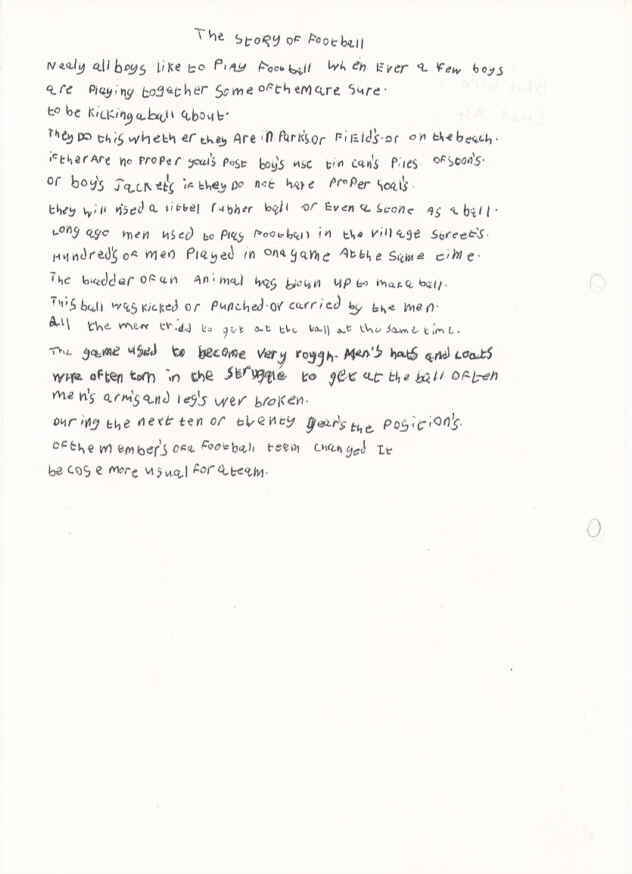
children's writng

Robbie Ogden
Year 4
http://www.lancaster.ac.uk/fass/projects/lever/PROJECTS/41/xc41/xc4106x.jpg


In this piece of writing, the child overgeneralises the grammatical function of apostrophes, using them frequently when not needed after a word contains the inflectional suffix 's', such as "boy's". This shows this child understands the rules of needing to use apostrophes for certain words but has over applied the rule in this text. These types of virtuous errors link to Chomsky that children have a sense of grammar as they haven't exactly been taught to use apostrophes at the end of every word with the inflectional suffix 's' but they are using it here.
Capital letters are also used in the middle of sentences on numerous occasions, such as "hundred's of men played in the same game At the same time." The child may have made this mistake here as the word 'at' can be frequently used at the start of sentences in children's writing.
The child also spelt words only with their salient sounds, such as "becos" and wer".


Year 5
http://www.lancaster.ac.uk/fass/projects/lever/PROJECTS/53/RO53/ro5305x.jpg


In this piece of work in year 5, the virtuous error of applying apostrophes to most, if not all, words ending in the inflectional suffix 's' doesn't occur anymore showing the progress they have made in a year. This may have been corrected independently, but more than likely a teacher helped him with his overgeneralisation and helped him understand where and when not to use them.
However, the grammatical error of using a capital letter in the middle of sentences still occurs, such as "hunt by Day".

Tuesday, 29 November 2016

Why reading is so difficult research

Learning to read is incredibly difficult due to all of the irregularities and complexities of our language, such as letters alone and groups of letters having completely different phonetics. For example, the video uses 'comparison' as an example - each word in 'comparison' can be sounded differently at least twice, most three or four times. This is the case with most, if not all words. The inflectional suffix of 'ough' is especially difficult due to it being pronounced in over 8 different ways, and one researcher talks about how confusing the English language can be to young learners and learners with difficulty, such as the letter 'f' being pronounced as an f in most words, but uses the fricative sound for the word 'of' - the f being pronounced as a 'v'. 
This difficulty and complexity to learn to read the same spellings in different ways can easily lead to problems in written communication and then with social interaction.

Dr. Louisa Moats - "Learning to read an alphabetic orthography is a very artificial and unnatural act".
Dr. Paula Tallal - "Reading is one of the more complicated higher cognitive functions to learn - need to use attention, sequencing, memory, linguistic system, visual systems - they all need to coordinate. The more complicated the translation is from the orthography to the phonology is in a language, the more complicated it is to understand.

Friday, 25 November 2016

Children's reading development research

Who are the most popular children's authors for early years, infants and juniors? What are the elements of these books that are successful? 
Eric Carle (The very hungry caterpillar), Marion Billet (Noodles love to eat) and Raymond Briggs (The snowman) are a handful of popular authors and their respective books for children in the early years of reading. These books are successful due to how they include simple aspects of reading but are still incredibly entertaining to young readers - they engage young readers by keeping the story line simple and include engaging factors such as colourful images involving animals which children really enjoy, and areas where children can use more of their senses such as to touch different sensitive areas like the fur of an animal.
Allan Ahlberg, Judith Kerr and Rod Campbell are popular authors for infants, and
Roald Dahl, Julie Donaldson and Michael Bond are popular authors for juniors.
As children get older and their reading capabilities and vocabulary increase in complexity, stories become more engaging by including a meaning to the story - a bit like a moral to the story - while books stay engaging this helps children in their wider learning as well as just reading.

How are children taught to read in schools (there are different approaches so read more than one source)? What are the arguments for and against current approaches? Make sure you cover synthetic phonics and reading schemes.

In school, children are taught to read in numerous ways, one of which is by the words phonemes - 'phonics'. This is the most widely known method to teach reading, where the children must first be taught the alphabet and learn the letters and sounds that the letters make. Once having learnt the single letter sounds they are taught to blend letters together, making simple words and then adding another letter and so forth, e.g. a-t, i-t, c-a-t, f-l-a-t. 
Another method is the 'language experience approach'. This involves where a child may draw an imagine, and the caregiver will write a sentence about that image, such as 'the cat sat on the hat'. The child can then trace over these words to understand the meaning of them - this is a way to enhance a child's vocabulary in a meaningful way. Some people use this method as a first approach to reading to help their student understand what they've drawn and what you have written is a form of communication.
Another method is the 'context support method'. This is where a book will contain a long sentence read by the caregiver, and a much simpler, shorter sentence available to read by the child, often just 1 or 2 words. The books help the child stay engaged by using images such as cars or animals.
'Look and say' is a 4th method used to help children read. Using this method children learn to understand whole words or short sentences instead of just sounds - children will look at a word which the caregiver says and try to repeat the sound. Flashcards with pictures are usually used here. It is recommended that short sentences rather than individual words are used for this method. The caregiver should write a short sentence representing a picture displayed. They will then say the sentence and ask the child to repeat it while pointing at each individual word as the child repeats it.

What sorts of 'miscues' (virtuous errors based on misapplication of reading skills) do young readers make and how are caregivers encouraged to deal with them (again, numerous ways)?
Examples of errors that readers make(especially struggling readers) are 'whole word' errors when trying to visually recognise entire words as a whole unit, instead of simplifying it and just processing the printed word by sound. These errors indicate that children are not processing the prints phonetically - they generally mistake words for 'sight words' words which they have already learnt that look similar to the word they are trying to say, a few examples are:
mistaking every for very, scrape for escape, and agree for argue.
Tracking errors are similar to whole word errors - in this case, children are not looking at the words from left to right to sound it out properly, they look at the word as a whole and mix up the letters in the word - in these errors, the words they say are often contain the same letters but are in the wrong order. Examples of these are was for saw and slip for spill. There are many other mistakes children can make, including word guessing errors and letter confusion.
To deal with these mistakes, adults and caregivers are encouraged to firstly praise the successes of the child's reading abilities, if they have correctly read other parts of the text. When dealing with the mistakes, they are advised to allow the child to speak even slower, making sure they aren't rushing over the words and reading them as a whole, ensuring they read properly from left to right, and are also advised to read aloud to the child to help them understand what they are reading and imitate how they say a word - linking to Skinner's idea that children learn language from imitation.

Tuesday, 18 October 2016

Analysing Zach transcripts

In the Banana transcript, Halla sets the agenda the majority of time, asking frequent interrogatives such as 'What are you doing now'? Despite setting the agenda frequently which shows her power in discourse potentially due to her power (social group) for being the older participant, the total of 30 interrogatives asked in fact shows her co-operation and rapport style to include Zach in the conversation and prompt him to do the majority of speaking to enhance his learning and vocabulary, suggested by Tannen and the female 'genderlect' of a rapport style. Halla also asks 10 open interrogatives which allows Zach to take centre stage in the conversation and have the majority of air time; in the Robot transcript Halla only asks 7 open questions which would assume Zach had less air time and a lower mean length of utterance. However, Zach had a mean length of utterance of 7.5 in the robot transcript compared to 5.4 in the banana transcript. This could be because Zach is over a year older in the robot transcript suggesting his speech and vocabulary has improved, although the reason of a higher MLU in the robot transcript could be because a a high number of closed questions were asked in the banana transcript (15), considerably more than in the robot transcript (4) which would essentially lower the MLU due to shorter answers needing to be required. Jerome Bruner's theory of child directed speech is also supported in the banana transcript due to 5 repeats/ prompts made by Halla to encourage Zach to speak and the fact that Halla pursued Zach's topic of interest throughout to keep them engaged, coming from the pragmatics and grammar sections of his theory. The prompts/repeats also support Skinner's theory of positive reinforcement to encourage a child's learning by praising and responding to a young learning child.

In the banana transcript Halla echoes Zach's non-standard uses on two separate occasions e.g. 'are the skins off are they?'; this may be because Halla wants to encourage Zach to keep speaking and not disrupt his confidence by negatively reinforcing his mistake of over-generalisation, instead using positive reinforcement by repeating and responding to what he said, again supporting Skinner's theory of operant conditioning to encourage a childs development. This over-generalisation also supports Chomskys theory that children have a sense of grammar which has been 'hard wired' into the brain due to Zach using the non-standard use which he has potentially never heard before - this virtuous error does show an understanding of language. Despite echoing the non-standard use of 'skins' and the improper syntax of 'I think I don't', Halla does use the effect of modelling as well when Zach mistakes bolognaise for bolognay to encourage Zach to use the adult form of the word, again showing positive reinforcement. This effect is shown due to the robot transcript a year later having no non-standard uses apart from the improper syntax ‘waiting to get better for it’ which included a reformulation suggesting he knew what he was going to say in the first instance was wrong so tried to correct it, and after Halla says the proper syntax of ‘waiting for the robot to get better?’ he quickly interrupts saying ‘yes yes’- this interruption and 2 other interruptions from the banana conversation show support of the dominance theory that males interrupt more than females; however the interruptions could be because of the context of Zach getting something wrong and then quickly wanting to show Halla that he does understand the word order – apart from this, the correct syntax is used throughout both transcripts, showing support for Chomsky’s theory that children do have an understanding of syntax before they are properly taught it.

Using simple sentences in the majority of sentences in the banana transcript, it seems that Zach had improved his vocabulary and ability over the course of the year in between transcripts due to using multiple compound sentences in the robot transcript using frequent coordinating conjunctions such as ‘so’. Despite this there were a lot more pauses in the robot transcript and in particular in the longer utterances, potentially showing that he was struggling during the long utterances. However this influent speech may be because of his illness during the time.

Because of the illness occurring during the robot transcript which impacted on the fluency of his speech, the data could be unreliable when drawing conclusions. However, the illness didn’t have a substantial impact which consequently impacted on his vocabulary as he used more compound sentences and had a higher MLU compared to the previous conversation. Overall the transcripts do support Chomsky’s theory of children having an understanding of syntax due to Zach using the correct syntax throughout both transcripts for all but two times, one for each transcript, one of which he tried correcting at the start and hastily replied to the modelled version of what Halla described, and also supports Chomskys theory due to Zach saying improper uses of language that he has never heard before such as ‘skins’, where this virtual error shows a natural understanding of language use. Skinners theory that development of language is mostly due to positive reinforcement is also supported due to Halla responding to both proper and improper uses of language from Zach and consequently caused his MLU to increase. 

Monday, 3 October 2016

Lesson - Monday 3rd Ocotber

"Taking turns in conversation"

The length between utterances in a conversation between two or more people is usually just 200 milliseconds - just a fifth of a second.

As adults, we indicate we don't want to be interrupted by using linguistic features e.g. talking more loudly, repeating words in the middle of a sentence, and paralinguistic features e.g. glaring at the interrupter.

Sensitive to gap lengths in adjacency pairs - when an interrogative is asked, if a break between utterances of around half a second occurs (break point), something is wrong, e.g. "can i borrow your pen?"  reply within a fifth of a second indicates normality, the receiver heard it etc.
Break in utterances of over half a second indicates a problem e.g. they didn't hear the interrogative, they don't want to give you their pen. To summarise, if this question was asked in a standard conversation, if the answer the receiver of the question wants to say is no, the length between utterances will be longer, because it is more difficult to say no than yes.

Tuesday, 27 September 2016

Halliday and Dore

Michael Halliday's functions of speech
In 1975, Michael Halliday identified that childrens langauge in their early years has 7 key functions. He believed that children are motivated to learn language as they believe it enables them to serve certain functions for them, such as to express their needs. This is ultimately named 'learning how to mean'.

4 of the 7 functions are labelled as helping the child satisfy physical, social and emotional needs.
Instrumental: When the child uses language to express their needs - Example - " I Want milk"
Regulatory: Where language is used to tell others what to do - Example - "Come here"
Interactional: Where language is used to form a relationship/ socially interact with others - Example "Love you mum"
Personal: Use of language to express the speaker's identity or/and feelings - Example - "I've been good today"
The other 3 functions are heuristic, imaginative, and representational. These help learning children understand the environment they are in.
Heuristic: When language is used to gain knowledge about the environment - Example - a running commentary of a child's activities "look at the fox"
Imaginative: Language is used to create expand the child's imagination, usually by telling stories
Representational: Using language to convey facts and information - Example "I have long hair".
John Dore's infant language functions
These are much more simple and basic to understand compared to Halliday's slightly more in-depth theory. Still similar to Halliday in the fact that children still learn language to develop necessary functions, they are just a lot more basic.
Labelling - Naming or identifying a person, object or experience
Repeating - echoing language spoken by a more accomplished speaker
Answering - Directly responding to an interrogative or declarative (or any utterance) by another speaker
Requesting action - demanding something e.g. food or drink
Calling - shouting/ loudly talking to attract attention
Greeting - simply saying "hi" or "hello" 
Protesting - Objecting to a request
Practising - Repeating language that the child speaks when no adults are assisting, trying to independently develop their language.

In the transcript, relating to John Dore's infant language functions, it is actually the accomplished speaker who does the repeating of words or phrases, acting as interrogatives; this may be used to enhance the learning of the young speaker and encourage them to keep talking which will inevitably enhance their language skills and ability.
Furthermore, just 1 of the 4 functions used to satisfy physical, social and emotional needs (Halliday) was used "i got food on the floor". The reason that the other 3 from that category such as instrumental function were not used was because Zach was mainly talking about what he was doing at that moment, not needing to request for things. Because of this, many heuristic and representational functions were used because the interrogatives being asked allowed for a running commentary style conversation to occur, where Zach was detailing what he was doing throughout the conversation, also showing the simple 'labelling' occuring from John Dore's theory, such as "here's the skins".

Monday, 26 September 2016

ideas of theory and data - investigation

distinctive features of language use - Most probable I will investigate
Robin Lakoff's deficit model - focus on if it is true that women use uncertainty features, possibly compare to if men use them at all, or compare a woman's in 3 different situations, making it reliable, e.g. formal interview, informal chat show etc - ensure i mention if it is planned speech.
Zimmerman and West - dominance - if it is true that men dominate conversations due to their 'perceived' superior status e.g. talk for 2x long, interrupt more - if so, make sure comparable factors are correct to enable this investigation to happen.

Language change
The change of language over time - effect of technology, social media - investigate the language of someones / a company's official website compared to twitter feed.
Historical changes of the English language over time - Shakespeare, 20th century, modern day

Language of certain jobs 
Sports commentary - how it is different from analysis after game and normal speech
Language of the media - how tabloids are different from other tabloids and broadsheets

Monday, 19 September 2016

19/09/2016 - Vygotsky

Vygotsky's zone of proximal development (ZPD
Zone of Proximal Development

 The zone of proximal development is defined as "the distance between the actual developmental level as determined by independent problem solving and the level of potential development as determined through problem solving under adult guidance, or in collaboration with more capable peers" by Lev Vygotsky in the last 10 years of his life. Because of his early death, this theory is not yet fully developed.
In a nutshell, it is the difference between what a learner can do without help and what they can do with help.
Vygotsky stated that a child will follow an adult's example of doing a task and gradually develop the ability to complete this task without any assistance.
Among other educational specialists, Vygotsky believed that the role of education is to provide children with tasks that are within their zone of proximal development to encourage them to keep learning.
He also believed that, instead of determining a child's knowledge based on tests given in schools (based on memory in a way), their development of their learning and knowledge should be based on their ability to solve problems independently and then with the assistance of an adult.
A concept of 'scaffolding' has been gradually developed by theorist Jerome Bruner, and furtherly developed by Wood and Middleton in 1975, supporting Vygotskys idea. They believe that this idea is that, when helping learning, a teacher or adult will help a child with a task within the child's ZPD, and will later reduce the amount of help as it becomes unneeded due to the child understanding what is needed to complete the task.


Monday, 5 September 2016

Me as an English Language student

As an English language student, I developed my skills of working effectively and efficiently on a variety of different pieces such as comparative essays and opinionated articles. What I found the most challenging was to quickly identify techniques used in a piece of work, such as the task in paper 1, and would also be unsure that if the techniques I identified were meaningful enough to write about to a good standard. To do well this year especially in paper 1, these skills of mine will need to be improved. 
Despite this, I enjoyed the topics learnt such as the effects that accent and dialect can have on your speech, most probably because I come from Bristol which has a unique dialect. Consequently, I use multiple traits from the Bristol dialect such as "where you to".

Tuesday, 28 June 2016

Creative piece

http://oadp.org/facts/13-reasons
Two wrongs don’t make a right – why the death penalty is wrong and even the worst of us still have the right to live – speech

Article 2 of the Human Rights Act 1998 – the right to life. The first and most important human right stated in the act. Yes, the majority of people on death row have taken someone else’s right to life away, but does that mean their life should automatically be taken away from them when found guilty of murder? Their most basic right violated? Do two wrongs make a right? Everyone knows that the answer to these questions are no. Seeing that murder is palpably wrong, and everyone knows and has been taught that from a young age, that murder is a punishable crime, then what is the point of the death penalty? What is it teaching us?
Think of the torture INNOCENT people go through when wrongly accused of murder and sentenced to death row, let alone the guilty criminals! The statistics on this matter is shocking; over 150 innocent human beings were set to endure the most inhumane experience anyone could possibly receive – life on death row (with the average time spent their being 11 years) – and tens of innocent people have been wrongly found guilty of murder and subsequently killed due to the death penalty, and yes ALL innocent. Imagine being that innocent person, knowing that a human error of misjudgement in the court will lead to the most inhumane experience happening to you – an innocent person. Or the person whose job it is to end the lives on death row, knowing deep down that they are guilty, but their life MUST come to an end, and you have the job of ending that innocent person’s life. Sickening. Luckily many convicts were eventually found not guilty, but still it is inexplicable that anyone can go through the terror of knowing they could be killed any minute of any day, be it they are innocent or not, for 11 years.
Forget the direct victims of this terrible idea, think for a second of the indirect victims. Imagine you were part of the firing squad – your job being to end the lives of others, the cruellest, most disgusting and most inhumane job there is on earth. How would you feel? Knowing how you pay your bills, how you are able to put food on the table, is to KILL other human beings. Yes human beings. These poor victims of this cruel penalty must be scarred for life. MANY workers on death row end up having terrible disorders such as Post Traumatic Stress Disorder. It is sickening, for both the criminal and the workers. Think of how their family members are affected. Their children, who may be frequently asked in schools “what do your parents do for a living”. They would need to reply with the utterly embarrassing statement of being part of the firing squad, to kill people on death row. How would you feel if you were that child? Having to share that your parent is essentially a murderer!
One of the main reasons for the death penalty is to act as a warning to other would-be criminals, where you would believe that is has a huge effect at dissuading serious crimes to be committed, especially the ones which merit a place on death row. So, what effect does the death penalty have? You may ask. The answer is little. Very little. The fact that the death penalty has minimal effect on dissuading criminals from murdering people or committing crimes resulting in being sentenced to death is both laughable and saddening. Multiple surveys from the United States show that there is an overwhelming majority of leading criminologists believing that the death penalty does NOT act as a deterrent to homicide crimes, and states where the death penalty is allowed have a higher homicide rate - 5% in 100,000 people – compared to states which have abolished the death penalty at 4% in 100,000 people! An incredible statistic with disgusting results. Capital punishment being pointless is an understatement.
I would like to conclude this by stating that not only is the death penalty inhumane and ineffective at stopping crimes, but the death penalty is essentially a lottery to when it is used - of the average 16,000 murders committed every year in the US, only around 120 of the defendants get killed – a measly 1%. With this being the case, why even have the death penalty? If only 1% of murderers will be sentenced to death row? Imagine being part of that 1%, knowing the vast majority of all other criminals will be able to live the rest of their lives, but yours must come to an abrupt end because of this ridiculous, lottery-esque excuse of REVENGE, not JUSTICE.
Thank you for listening.

Monday, 27 June 2016

Mini saga

BANG.
The bus had been shattered. Destroyed. Obliterated.
They had never witnessed anything like this before.
Deafening cries and shrieks were heard from nearby.
The news slowly started to filter through to loved ones.
"Don't get upset son" said the father, "You have plenty more toys you can play with".

Tuesday, 14 June 2016

informative text samples

http://www.theguardian.com/media/mind-your-language/2016/feb/04/english-neologisms-new-words

http://www.telegraph.co.uk/news/newstopics/howaboutthat/11574196/new-forms-of-social-media-terms-which-parents-do-not-understand.html

My findings from Mondays lesson - 14/06/16

Book title - The language report
Author - Susie Dent
Year the book was published - 2003
First edition
Published by - Oxford University Press (OUP) in 2003
Area/city published - New York
Pages - 160

"We should need new words. The old ones just wouldn't fit."

This quote from Susie Dent shows two statements I can test - firstly, the need, use and creation of new words, and secondly how the meanings of words changing, relating to how the old ones no longer 'fit'.